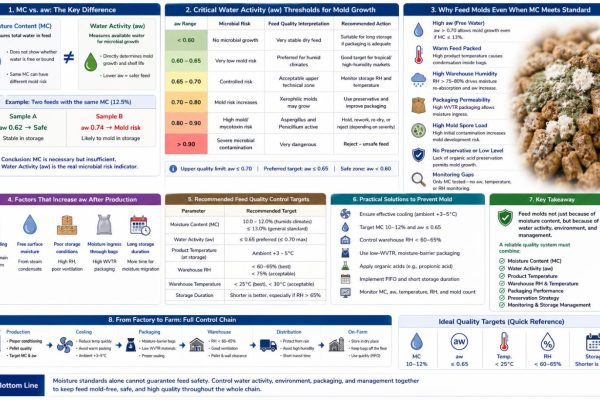

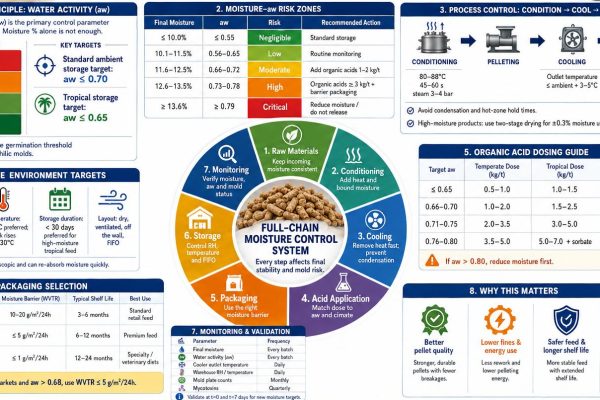
Why Does Feed Mold Even When Moisture Meets Standard?

Finished animal feed may still develop mold even when its measured moisture content meets the factory or national standard. This quality failure is common in feed mills, especially in tropical, subtropical, rainy-season, coastal, or poorly ventilated storage environments. The main reason is that moisture content (MC) measures total water, while mold growth is governed primarily…

Read More
Temperature and Humidity Management in Feed Warehouses

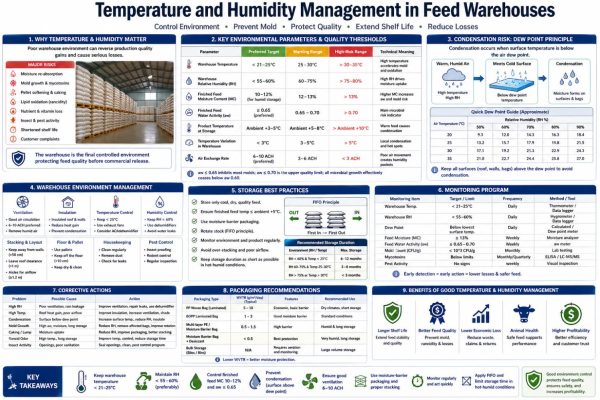
Temperature and Humidity Management in Feed Warehouses

Temperature and humidity management in feed warehouses is a critical control point for maintaining the quality, safety, shelf life, and commercial value of finished animal feed. Even when feed is correctly manufactured, pelleted, cooled, and packaged, poor warehouse environmental control can rapidly reverse production-stage quality gains. High relative humidity, elevated temperature, poor airflow, condensation, direct…

Read More

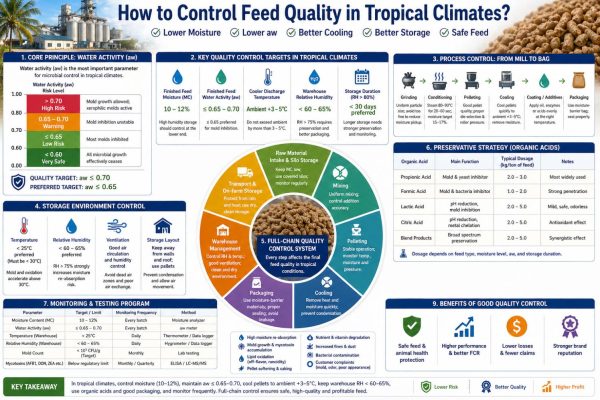
How to Control Feed Quality in Tropical Climates?

Feed quality control in tropical climates is technically more difficult than in temperate regions because high ambient temperature and relative humidity accelerate moisture re-absorption, mold growth, mycotoxin production, lipid oxidation, nutrient degradation, pellet softening, and bacterial persistence. In tropical and subtropical markets, ambient temperature commonly reaches 30–38°C, while relative humidity frequently exceeds 75–85%. Under these…

Read More

    * We understand that privacy is important to you, so we will only answer the questions you ask and will not disclose your information to third parties.